Bacchus

Crossing
(Silvaner x Riesling) x Müller-Thurgau
Origin
Bacchus was bred in 1933 by Peter Morio at the Geilweilerhof Institute for Grapevine Breeding in Siebeldingen. The variety originated from a cross between (Silvaner × Riesling) and Müller-Thurgau. It was named after Bacchus, the Roman god of wine. Due to its aromatic profile and comparatively early ripening, Bacchus became widely planted primarily in Germany, with significant cultivation in Franken, Rheinhessen, and the Pfalz. The variety also plays a notable role in England, as its reliable ripening performance makes it well-suited to the country’s cooler climate.
Characteristics
- mid-early budburst
- early ripening
- medium to high vigour
- susceptible to late spring frost
- high yield potential
- susceptible to botrytis, thin berry skins
Site requirements
Bacchus has moderate site requirements and ripens comparatively early, making it well-suited to slightly cooler sites where late-ripening varieties struggle to reach full ripeness reliably. Warm, airy sites with deep, nutrient-rich soils and an adequate water supply offer ideal conditions, whereas cold soils prone to waterlogging are unsuitable. Due to its relatively early budburst, the variety faces an increased risk of late spring frost. Furthermore, excessive crop loads combined with a dense canopy heighten the risk of botrytis.
Aromas
Bacchus produces floral and fruit-driven wines with a delicate muscat aroma. At higher ripeness levels, it can also yield Spätlese and Auslese styles with intense, pronounced bouquet. Conversely, when yields are too high or on cold, wet sites, the wines can turn out unripe, short on the finish, and less harmonious.
Bunch
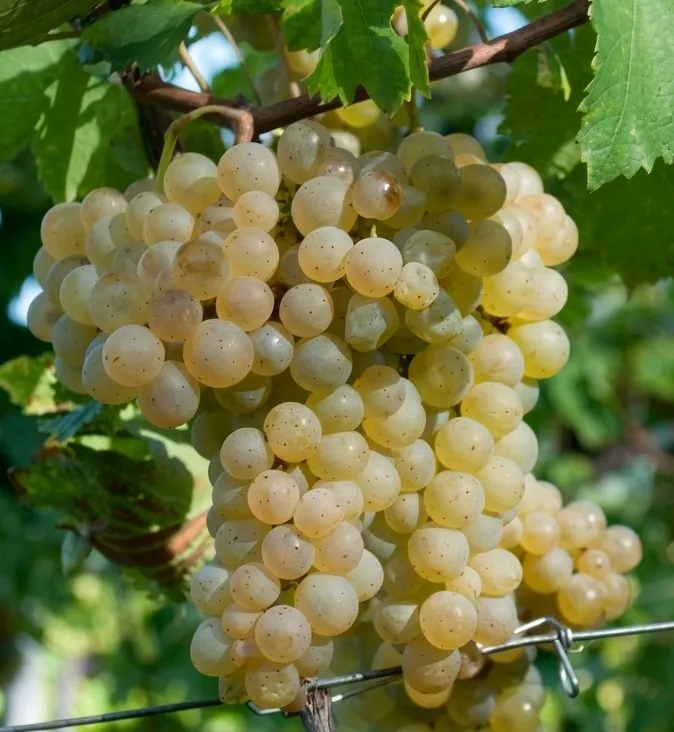
Bacchus bunches are medium-sized, shouldered, and mostly compact. The medium-sized berries are round to oval and turn from yellow-green to yellow as they ripen. They are thin-skinned with a juicy, aromatic flesh displaying a subtle to pronounced muscat note. Due to the compact bunch architecture and thin berry skins, there is an increased risk of bunch rot in damp weather conditions.
Bacchus clones
Geilweilerhof

Bacchus Gf 1
Yield above averageBunches compactBotrytis susceptibility above average
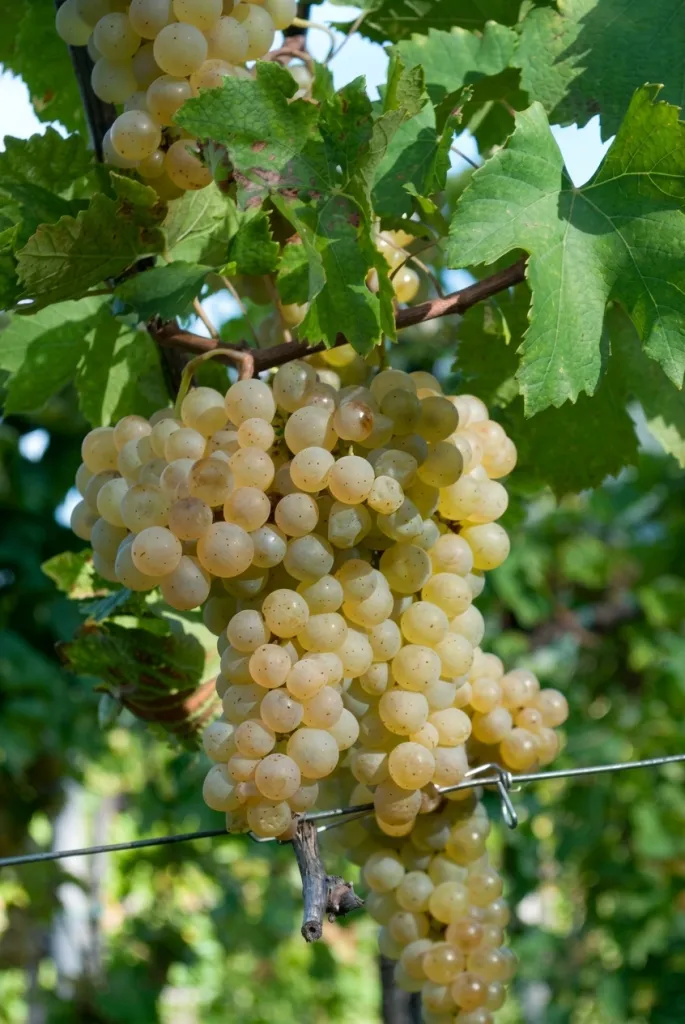
- T137, CC BY-SA 3.0 via Wikimedia Commons (Variety image, Bacchus Gf 1)