Chenin Blanc

Crossing
Savagnin Blanc x ?
Second parent unknown to date.
Synonyms: Pineau de la Loire, Pineau d’Anjou, Steen
Origin
Chenin Blanc is a historic white grape variety from France’s Loire Valley. Its original homeland is widely considered to be Anjou in the western Loire Valley, from where Chenin Blanc later spread into the neighbouring wine region of Touraine around the city of Tours. Its history stretches far back: a document from 845 mentions a vine called “Plant d’Anjou” in connection with the abbey of Saint-Maur de Glanfeuil. Whether this actually referred to Chenin Blanc, however, cannot be proven beyond doubt. By the 15th and 16th centuries at the latest, the variety was established in the region. The name Chenin Blanc is said to derive from a hill called Mont Chenin in the French region of Touraine.
According to DNA analysis, Chenin Blanc is a cross between Savagnin Blanc (an ancient variety of the Traminer family) and a second variety that remains unknown to this day. Sauvignon Blanc and Trousseau are considered its close relatives.
In addition to France, Chenin Blanc is also cultivated in the USA, South Africa, Argentina, Australia, and New Zealand. In South Africa, Chenin Blanc is the most widely planted variety, accounting for around 16,000 of approximately 86,500 hectares (2025), or just over 18% – considerably more than in France.
Characteristics
- early budburst
- late ripening
- susceptible to late spring frost
- good wood maturity
- moderate vigour
- less upright growth habit
- stable acidity
- susceptible to botrytis
- thin berry skins
Site requirements
Chenin Blanc favours well-exposed, sufficiently warm sites that are as sheltered as possible from late spring frost. Owing to its late ripening, a long growing season is required for the grapes to reach full ripeness. The variety is adaptable to a wide range of soils, thriving on slate and sandstone as well as calcareous and clay-rich sites. Well-drained soils are advantageous. In cooler winegrowing regions, sheltered hillside sites are particularly well-suited, whereas in warmer climates, less exposed sites can also yield good results.
Aromas
Chenin Blanc possesses a versatile aromatic profile that depends primarily on ripeness level, origin, and winemaking style. Young, dry wines typically display aromas of green apple, pear, and citrus fruits, with vibrant acidity providing freshness and structure. As ripeness increases, notes of quince, peach, and apricot emerge. In warmer winegrowing regions such as South Africa, tropical notes like pineapple and mango appear, alongside herbal, spicy, or mineral nuances depending on origin. Very ripe or oak-aged wines often exhibit notes of honey and beeswax.
The variety lends itself to a wide range of styles, from dry white wines and noble-sweet wines to sparkling wines. In the Loire Valley, it is a key component of Crémant de Loire.
Bunch
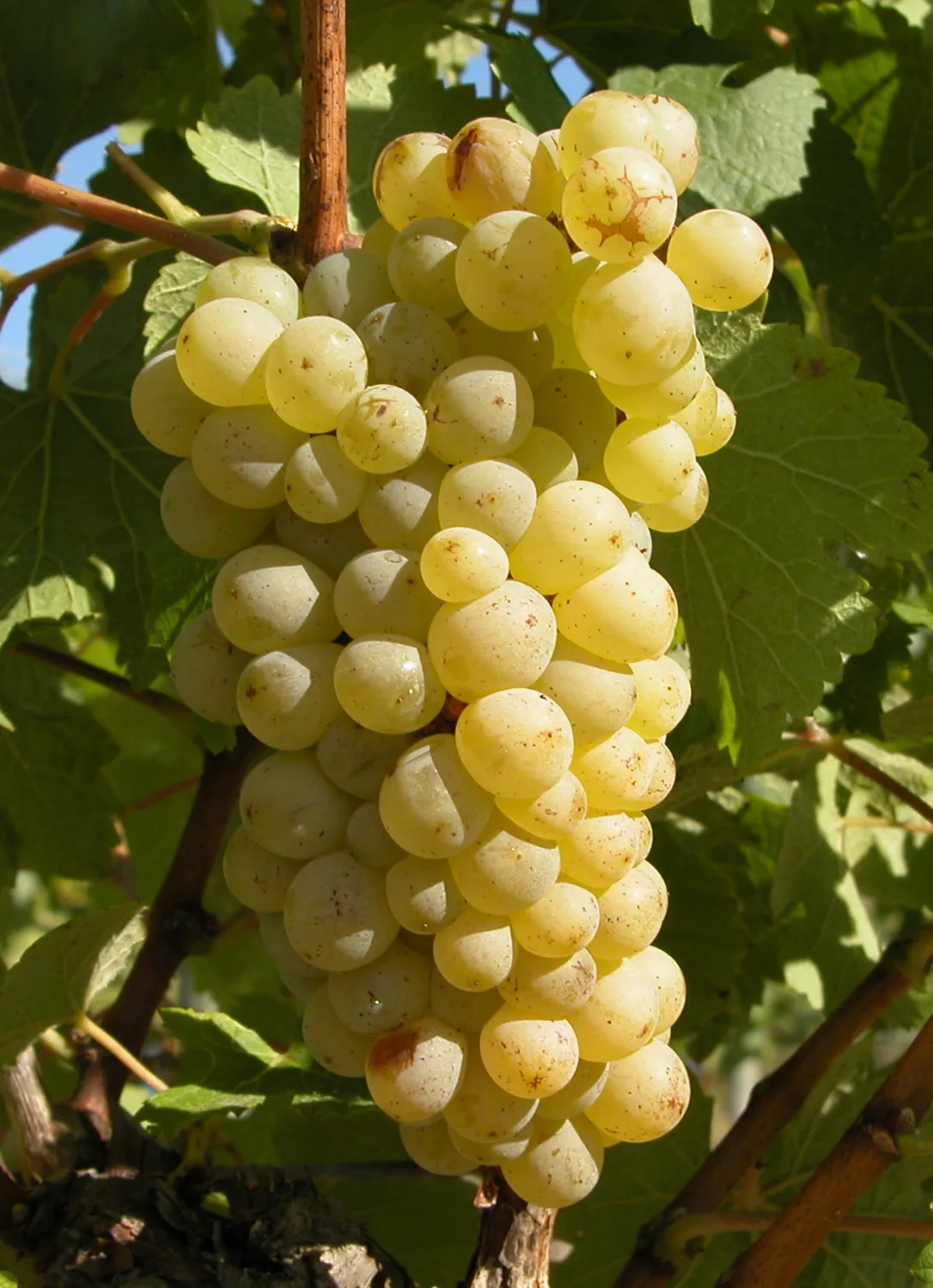
The bunches are medium to large, conical, and frequently shouldered. The berries are small to medium-sized, roundish to slightly oval, and turn yellowish to golden-yellow at full ripeness. The compact bunches feature relatively thin berry skins.
Links/Downloads
Chenin Blanc clones
France
Chenin Blanc ENTAV-INRA 220
Yield mediumBunches compactBotrytis susceptibility low to medium
- Quality clone
- PlantGrape (Variety image)